
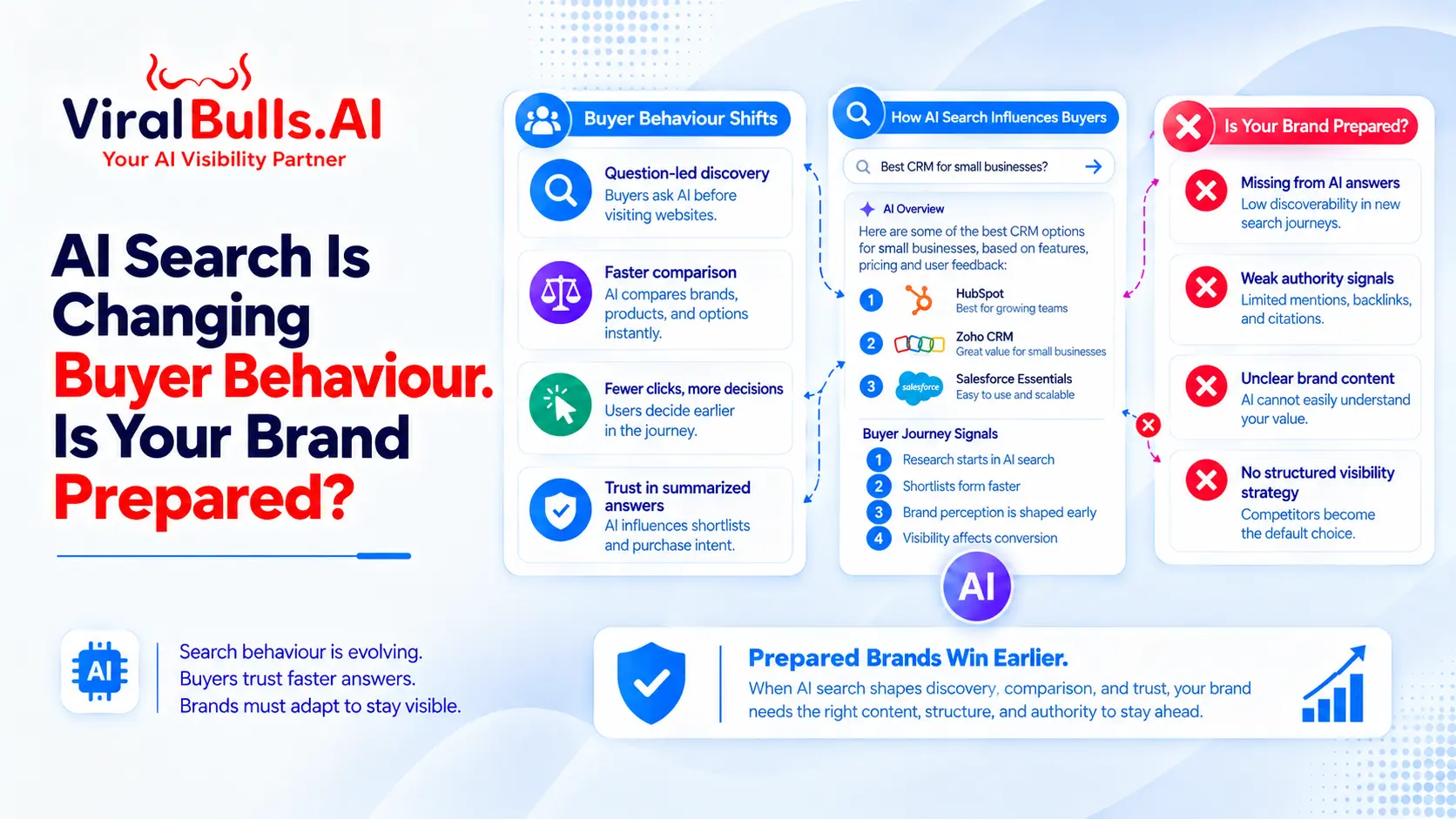
A buyer once searched for ‘best accounting software’ and opened several results. Today, the same buyer may ask an AI assistant to compare three platforms for a fifty-person company, explain implementation risks, and recommend questions for the sales call.
The query is longer, the expectation is higher, and the answer may shape the shortlist before any website visit.
AI search is changing how people research, compare, and trust brands. Businesses need to prepare for a journey where visibility may occur inside an answer rather than only on a results page.
Buyer Questions Are Becoming More Detailed
Conversational interfaces encourage users to provide context, constraints, budgets, industries, and goals.
Brands need content that addresses real decision factors rather than repeating broad keywords. FAQs, comparisons, implementation guides, case studies, and expert analysis become more useful.
Research Is Becoming Compressed
AI can summarize several sources into one response. This reduces the time buyers spend visiting basic informational pages.
To stand out, a brand needs distinctive evidence, clear positioning, and information that cannot be replaced by a generic summary.
Trust Is Evaluated Across Sources
AI answers and buyers may compare the company website with reviews, directories, media, professional profiles, forums, and other sources.
Consistent service descriptions, leadership information, customer evidence, and external mentions help reinforce credibility.
Brand Discovery Can Happen Without a Click
A buyer may learn a company name in an AI answer and later search for it directly. Traditional analytics may not show the original influence clearly.
This makes branded search, direct traffic, assisted conversions, and customer-reported discovery more important.
What AI Search Optimization Requires
- Strong technical SEO and crawlable content
- Clear topic and service architecture
- Entity consistency across owned and external profiles
- Original evidence, examples, and expert insight
- Content covering comparison and decision questions
- Accurate structured data where relevant
- Reviews and credible third-party mentions
- Conversion paths that confirm the recommendation
What Brands Should Avoid
Do not mass-produce generic AI content, create artificial mentions, stuff pages with question variants, or claim guaranteed inclusion in answers.
AI search optimization should improve usefulness and credibility, not manipulate systems through low-value volume.
Prepare the Website for Recommendation Traffic
Visitors arriving after an AI recommendation may already know the category. They need confirmation: why this company, for whom, with what proof, and what happens next.
Service pages and case studies should provide specific information quickly. Contact and follow-up systems should preserve the visitor’s context.
How AI SEO Services Support the Shift
AI SEO services can combine technical audits, topic mapping, entity work, content production, evidence development, authority strategy, and new search measurement.
The work should strengthen both Google visibility and AI-assisted discovery rather than treating them as competing channels.
How ViralBulls Prepares Brands for AI-Led Discovery
ViralBulls helps businesses understand how customers search, what information influences decisions, and where the brand lacks authority or clarity.
We combine SEO, GEO, content, digital PR, website conversion, and automation to create a search presence that is useful across changing interfaces.
Final Thought: Prepare for the Buyer, Not Only the Algorithm
AI search matters because buyer behavior is changing. The most durable strategy is to provide clear answers, trustworthy evidence, and a strong customer experience wherever discovery begins.
How Buyer Behaviour Is Changing
| Before | Now | Brand Requirement |
| Short keyword | Detailed conversational question | Content reflecting context and constraints |
| List of links | Synthesized answer | Clear and citable information |
| Website-first research | Cross-source validation | Consistent brand and proof signals |
| Click-based attribution | Recommendation influence | Multi-touch measurement |
| Generic landing page | Expectation of fast confirmation | Specific proof and next steps |
AI Assistants Are Becoming Research Partners
Buyers use conversational systems to refine questions, challenge assumptions, create shortlists, and prepare for sales conversations. Each follow-up adds context, so the recommendation can become more specific than a traditional broad keyword result.
Brands should study the questions customers ask before and after they understand the category. These sequences reveal content opportunities that static keyword lists may miss.
Example: A Healthcare Buyer
A clinic administrator may ask about software categories, data protection, implementation time, and integration requirements before requesting vendor names. A company with only promotional landing pages may not appear useful during this research.
Detailed, reviewed content covering risks and implementation can build credibility. In sensitive industries, accuracy and expert oversight are more important than publishing speed.
Prepare Sales for Better-Informed Buyers
AI-assisted buyers may arrive with detailed comparisons, pricing expectations, and objections. Sales teams should know which claims are visible online and be ready to explain differences without contradicting marketing content.
Conversation summaries and shared knowledge bases can help marketing and sales learn from these interactions, creating a feedback loop between buyer behavior and content.
Do Not Optimize for One Model Snapshot
Answer systems change their sources, interfaces, and outputs. A tactic that appears to work for one prompt may not create durable visibility.
Build strong information assets, reputation, and customer value instead of reverse-engineering isolated answers. Durable readiness is broader than a single platform.
How Content Teams Should Adapt
Content planning should move beyond a flat list of keywords. Teams can map question chains: what buyers ask before they understand the problem, what they ask when comparing approaches, and what they need before approving a purchase.
Each piece should have a clear role and link to supporting evidence. Expert review is especially important for legal, medical, financial, and technical topics where inaccurate simplification creates real risk.
AI can help identify patterns and repurpose material, but the brand should contribute experience, examples, and judgment. Otherwise, the content becomes another generic summary competing with answers that can already summarize the same public information.
A Brand Preparedness Checklist
A prepared brand can answer five questions clearly. What does the company do? Who is it best suited for? What evidence supports the claims? How does it differ from alternatives? What should a buyer do next?
Review whether these answers are consistent across the website, profiles, reviews, sales materials, and public mentions. Then assess whether important pages are technically accessible and whether complex buyer questions have useful, reviewed answers.
Preparation also includes internal readiness. Sales and customer teams should know how the brand is represented online, and marketing should have a process for correcting outdated or misleading information quickly.
AI Search and Brand Strategy
As basic information becomes easier to summarize, distinctive positioning becomes more important. Brands that sound identical give answer systems and buyers little reason to choose one over another.
Clear specialization, original experience, strong proof, and a recognizable point of view create value beyond optimization. AI search readiness is therefore partly a brand strategy challenge.
Buyer Expectations Are Rising
When AI can provide a tailored summary instantly, buyers become less patient with vague websites and slow answers. They expect companies to understand context and explain trade-offs clearly.
Brands should respond by making expertise accessible, not by automating every interaction. Fast information should lead to better human conversations when the decision becomes complex.
Frequently Asked Questions
It refers to search and answer experiences that use generative AI to synthesize information and respond conversationally.
Buyers ask more detailed questions, receive compressed research, and may form shortlists before visiting websites.
It is the work of improving technical access, content clarity, authority, entity signals, and evidence for AI-assisted discovery.
Yes. It remains a core foundation for discoverability and quality.
Use available feature reporting, branded search, assisted conversions, customer surveys, and sales feedback.
Audit whether the website clearly explains the brand, covers decision questions, and provides credible evidence.