
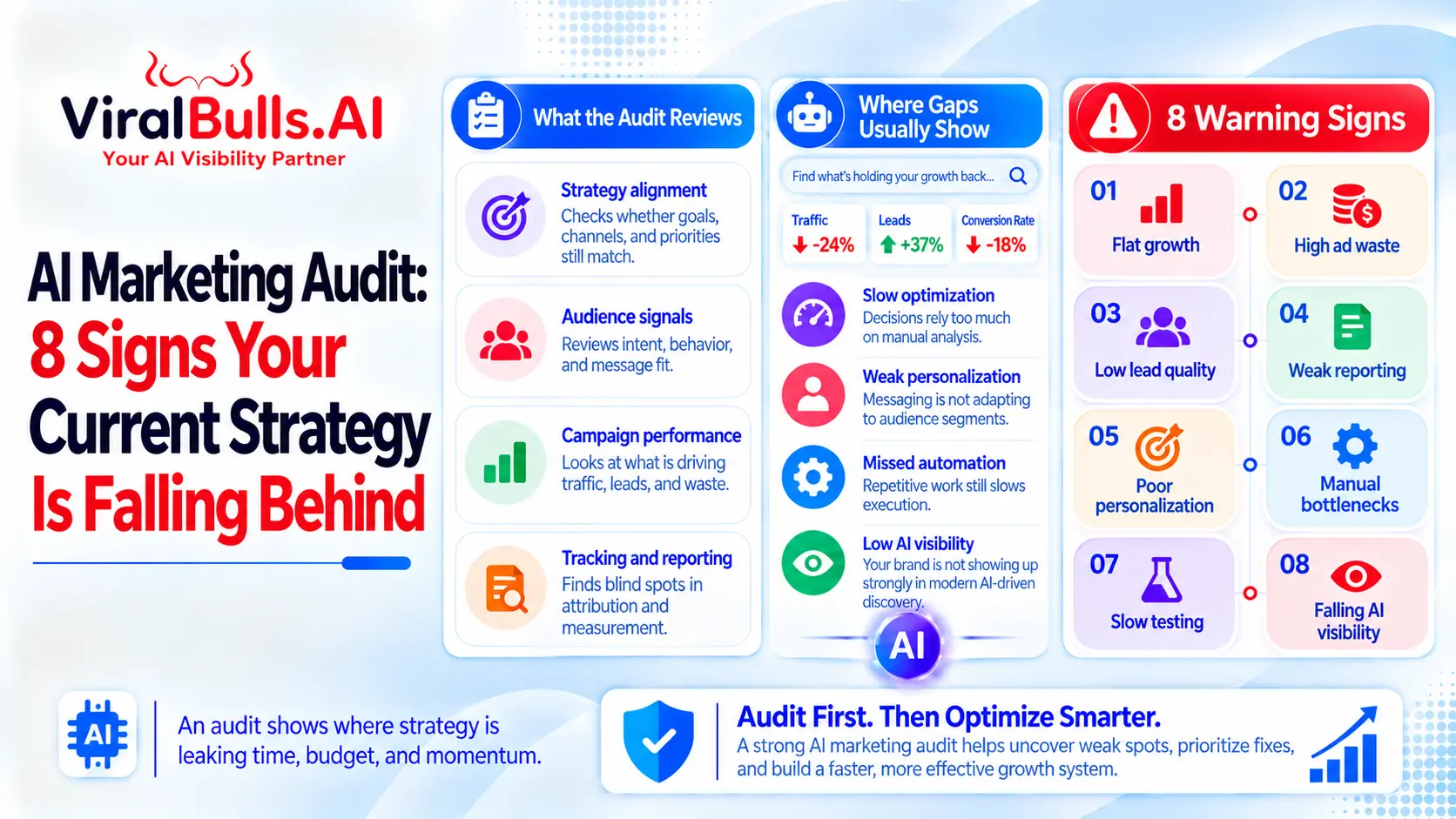
The team is publishing content. Ads are running. Emails are being sent. Reports are delivered every month.
From the outside, the marketing operation appears active.
But leads take too long to receive a response. Campaigns reuse the same creative. SEO content targets yesterday’s search behaviour. Customer data sits across disconnected platforms. Reporting describes what happened without helping anyone decide what to do next.
Activity is not the same as progress.
An AI marketing audit examines whether your current strategy can learn, adapt, and operate at the speed customers now expect. It does not begin by asking which AI tools you have purchased. It asks whether technology, data, workflows, content, and decision making are working together.
What an AI Marketing Audit Should Evaluate
A useful audit reviews more than creative output.
It should examine strategy, search visibility, paid advertising, content production, lead handling, CRM quality, automation, analytics, governance, and the skills available inside the team.
The objective is to identify where AI can create measurable value and where basic marketing foundations must be fixed first.
AI marketing services should not automate a broken process. They should help the business simplify the process, improve the data, and introduce intelligence only where it supports a clear outcome.
Sign 1: Your Team Still Does High-Volume Repetitive Work Manually
Marketers may spend hours compiling reports, rewriting similar campaign variations, tagging leads, summarizing calls, routing enquiries, or moving data between tools.
Simple rules may handle confirmations and notifications. AI may add value when the work involves classification, summarization, prediction, or content variation.
Sign 2: Every Customer Receives the Same Journey
Basic segmentation by age, location, or industry is no longer enough for complex buying journeys.
A prospect who read three technical articles, visited pricing, and returned through a branded search should not receive the same communication as someone who downloaded an introductory guide.
AI can support lead scoring, next-step recommendations, content selection, and account summaries. But personalization should remain relevant and respectful rather than becoming intrusive.
If your customer journey is identical regardless of behaviour or intent, the strategy may be leaving valuable context unused.
Sign 3: Your Content Strategy Is Built Only Around Keywords
Keywords remain important, but search is increasingly shaped by questions, entities, comparisons, and AI generated answers.
A content plan that produces isolated articles without topic depth, original evidence, internal links, or clear brand expertise may struggle to build lasting visibility.
An AI marketing agency should examine whether the website answers the wider decision journey and whether search systems can understand the company’s services, audience, and authority.
AI assisted content can improve research and production, but scaled generic content can weaken quality if human expertise is missing.
Sign 4: Campaign Creative Is Not Tested Fast Enough
Paid advertising performance can decline while teams wait for the next shoot or design cycle.
If one video or banner is expected to serve every audience for months, the campaign is not learning quickly enough.
AI can help create hook variations, formats, localizations, and message tests. It should not be used to publish unlimited low quality assets.
An audit should review creative volume, fatigue, approval time, testing logic, and whether performance insights are being converted into the next production brief.
Sign 5: Leads Are Lost Between Marketing and Sales
A lead submits a form, but the record reaches sales without context. The source is unclear. The requested service is missing. No follow-up task is created. The first response arrives two days later.
This is not only a sales problem. It is a marketing system problem.
AI marketing services can support lead qualification, summaries, routing, and prioritization, while basic automation handles notifications and CRM updates.
The audit should trace every point where data, ownership, or speed breaks down.
Sign 6: Reporting Explains the Past but Does Not Guide Decisions
Many dashboards contain impressions, clicks, sessions, and engagement metrics without showing what should change.
AI can summarize patterns, detect anomalies, and surface questions, but it should not replace analytical judgment.
A strong reporting system connects channel metrics to qualified leads, pipeline, revenue, retention, and customer value.
If teams spend the reporting meeting debating whose numbers are correct, data governance must be addressed before adding more intelligence.
Sign 7: Your Technology Stack Has More Tools Than Integration
Businesses often buy specialized tools for email, CRM, ads, analytics, chat, content, and automation. Each tool may work individually while the overall system remains fragmented.
Disconnected tools create duplicate records, inconsistent attribution, manual exports, and conflicting customer histories.
An AI marketing audit should map systems, data ownership, permissions, integrations, and unused capabilities. The solution may involve consolidation rather than another subscription.
Sign 8: AI Use Has No Governance
Employees may already be using public AI tools to draft content, analyze customer information, or create campaign assets without formal guidance.
This creates risks around confidential data, inaccurate claims, copyright, identity, approvals, and brand consistency.
Governance should define approved tools, permitted data, review requirements, access controls, record keeping, and use cases requiring human approval.
FTC guidance continues to emphasize that advertising claims must be truthful, not deceptive, and supported by evidence. Adding AI does not reduce that responsibility.
AI Marketing Audit Scorecard
Use this scorecard to identify where the strategy needs attention.
| Area | Healthy Signal | Warning Sign |
|---|---|---|
| Operations | Repetitive tasks are automated appropriately | Teams copy, classify, and report manually |
| Customer journey | Messages reflect intent and stage | Everyone receives the same sequence |
| Search and content | Connected topic authority and original value | Isolated keyword articles |
| Creative | Frequent structured testing | Same assets run until fatigue |
| Lead management | Fast routing with useful context | Slow follow-up and incomplete records |
| Measurement | Metrics connect to pipeline and revenue | Reports list activity without decisions |
| Technology | Integrated, governed data flow | Duplicate tools and manual exports |
| Governance | Approved tools and review rules | Uncontrolled use of customer data and AI |
What Should Happen After the Audit?
An audit is valuable only when it produces a clear action plan.
Start with the problems that have clear business impact and enough data to measure improvement. A practical roadmap may include CRM cleanup, response-time automation, content restructuring, creative testing, reporting alignment, or one narrow predictive use case.
Each initiative should have an owner, baseline, expected outcome, risk controls, and review date.
Do not attempt to automate the entire marketing department in one quarter. Early wins should build confidence and create the data discipline required for more advanced work.
How ViralBulls Conducts an AI Marketing Audit
ViralBulls reviews marketing as one connected operating system.
We evaluate strategy, search, content, paid media, creative production, lead workflows, CRM, automation, analytics, and governance. We identify where basic automation is sufficient and where AI can add meaningful judgment, speed, or scale.
Our AI marketing services are designed around business outcomes rather than tool adoption. The result is a prioritized roadmap explaining what to fix, what to automate, what to test, and what should remain human led.
A good audit should leave the business with greater clarity, not a longer software shopping list.
Final Thought: Falling Behind Usually Looks Normal at First
Marketing strategies rarely become outdated overnight.
They fall behind gradually through slow responses, repetitive creative, disconnected data, shallow content, and decisions based on incomplete reporting.
An AI marketing audit reveals those gaps before they become expensive.
The businesses that gain the most from AI will not be the ones using the largest number of tools. They will be the ones that improve the underlying process and apply intelligence where it creates a measurable advantage.
Frequently Asked Questions
It is a structured review of marketing strategy, data, workflows, content, technology, automation, measurement, and governance to identify where AI can create practical value.
No. It may reveal that the first priority is improving data, integrations, or basic automation rather than purchasing new AI software.
Timing depends on business size and complexity. A focused review may take a few weeks, while a multi-brand or multi-market audit may require deeper discovery.
Useful inputs include goals, channel performance, CRM data, customer journeys, campaign processes, technology access, reports, content, and existing automation workflows.
A strong agency should help the team work more effectively, clarify roles, and build systems. It should not assume that technology can replace every marketing capability.
The output should include findings, priorities, opportunities, risks, recommended use cases, measurement baselines, owners, and an implementation roadmap.