Search engine optimization has always evolved alongside the way people search.
Years ago, businesses could improve rankings by optimizing keywords, building backlinks, publishing useful content, and improving technical website performance. These fundamentals still matter. But search itself is changing.
Today, people are not only typing short queries into Google. They are asking conversational questions, using AI assistants, comparing recommendations generated by AI platforms, and expecting direct answers instead of scrolling through multiple search results.
This shift has introduced a new approach to optimization: AI SEO.
Traditional SEO focuses primarily on improving visibility within conventional search engine results. AI SEO expands that objective by using artificial intelligence to analyze search behavior, automate optimization, identify opportunities, and help brands become discoverable across both search engines and AI-powered discovery environments.
So, does AI SEO replace traditional SEO?
Not exactly.
The most effective digital marketing strategies increasingly combine the strengths of both.
What Is Traditional SEO?
Traditional SEO refers to the established techniques businesses use to improve their website’s visibility in organic search engine results.
Its primary objective is straightforward: help search engines understand a website so that relevant pages can rank for queries potential customers are searching for.
Traditional SEO usually involves several core disciplines.
Keyword Research
SEO professionals identify keywords that potential customers enter into search engines.
For example, a digital marketing company might target searches such as:
- SEO services
- Digital marketing agency
- Local SEO company
- Performance marketing services
- Content marketing agency
Keyword research traditionally considers factors such as search volume, competition, relevance, and commercial intent.
On-Page SEO
On-page optimization improves individual website pages.
This commonly includes:
- Page titles
- Meta descriptions
- Heading structure
- Keyword placement
- Internal linking
- Image optimization
- URL structure
- Content quality
The objective is to make the page useful for visitors while helping search engines clearly understand its topic.
Technical SEO
Technical SEO focuses on how efficiently search engines can crawl, render, understand, and index a website.
Important elements include:
- Website speed
- Mobile usability
- Crawlability
- Indexation
- XML sitemaps
- Canonical tags
- Structured data
- HTTPS
- Core website architecture
A technically weak website can struggle to rank even when its content is strong.
Off-Page SEO
Traditional SEO also relies heavily on authority signals outside the website.
Backlinks from relevant and trustworthy websites can help demonstrate credibility and topical authority.
Off-page SEO may include:
- Guest posting
- Digital PR
- Link building
- Brand mentions
- Business citations
- Industry publications
Human-Led Strategy
One of the defining characteristics of traditional SEO is its dependence on human expertise.
SEO professionals manually interpret keyword data, analyze competitors, develop content strategies, identify technical issues, and decide which opportunities deserve attention.
This human judgment remains extremely valuable because SEO decisions often depend on context that numbers alone cannot explain.
What Is AI SEO?
AI SEO applies artificial intelligence, machine learning, natural language processing, automation, and large-scale data analysis to SEO activities.
However, AI SEO should not simply be understood as “using ChatGPT to write SEO content.”
That is only a small part of the picture.
A sophisticated AI SEO strategy uses AI to improve how marketers research, optimize, measure, and scale organic visibility.
AI can analyze enormous amounts of search, content, competitor, and behavioral data much faster than manual analysis.
For example, an AI-assisted SEO workflow might identify hundreds of related search topics, group them by intent, detect content gaps, recommend internal links, analyze SERP patterns, and prioritize pages based on ranking potential.
AI SEO therefore changes both the speed and depth of optimization.
AI SEO vs Traditional SEO: The Main Differences
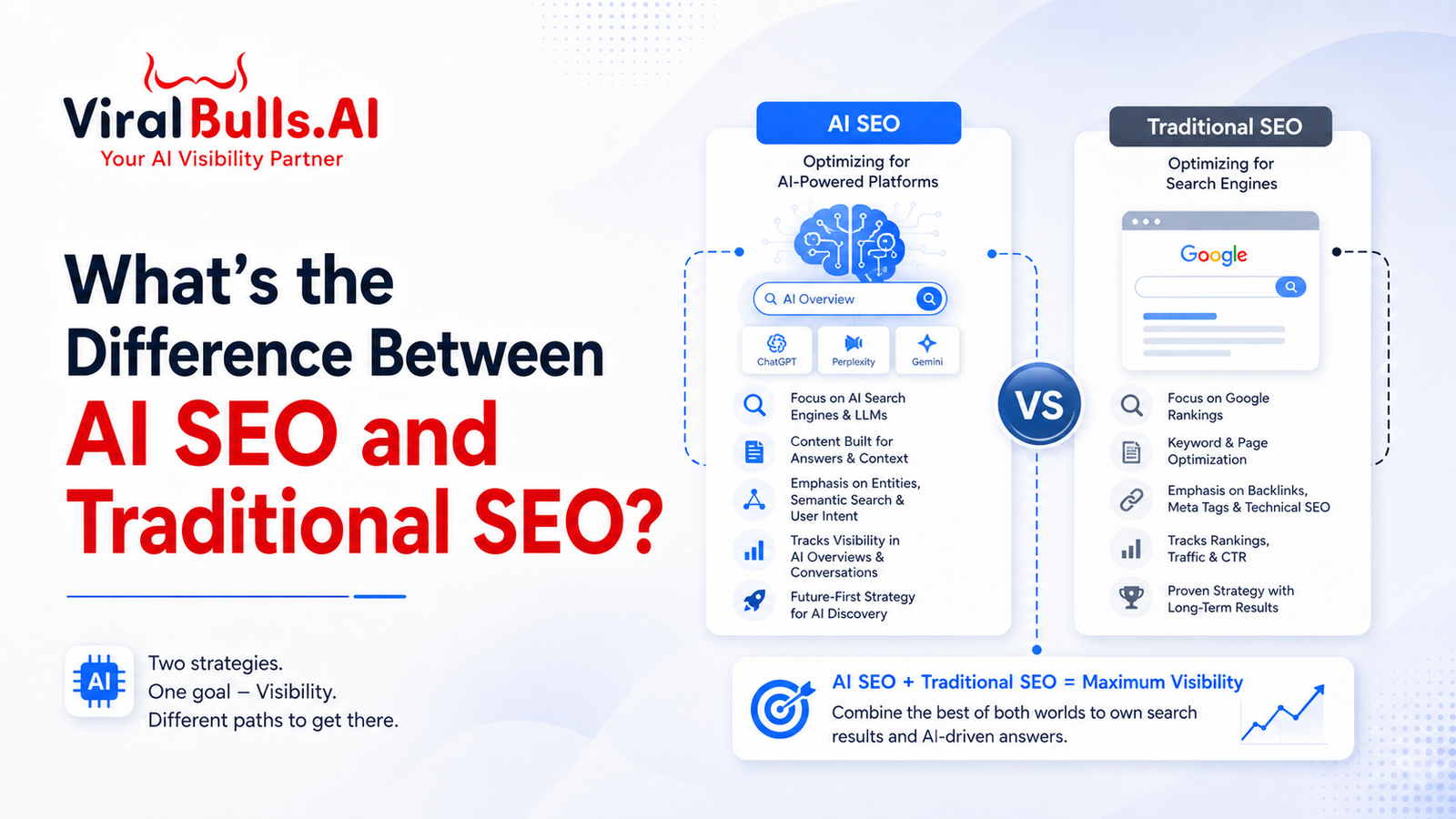
Although both approaches ultimately aim to improve online visibility, their methodologies can differ significantly. A detailed comparison of traditional SEO and AI SEO can help clarify how the two approaches differ.
1. Keyword Focus vs Search Intent Understanding
Traditional SEO has historically placed considerable emphasis on keywords.
A marketer might identify a primary keyword, several secondary keywords, and optimize a page around them.
AI SEO goes deeper.
Artificial intelligence can analyze relationships between:
- Topics
- Entities
- Questions
- Search intent
- User journeys
- Semantic meaning
- Conversational queries
Instead of asking:
“Which keyword should this page rank for?”
AI SEO may ask:
“Which questions, topics, entities, and user needs should this page comprehensively address?”
This creates a more topic-driven optimization strategy.
2. Manual Research vs Automated Data Analysis
Traditional SEO research can be extremely time-consuming.
An SEO specialist may manually review:
- Search results
- Competitor websites
- Keyword lists
- Backlink profiles
- Content gaps
- Ranking changes
AI can significantly accelerate this process.
Machine learning systems can process large datasets and identify patterns that would take humans substantially longer to discover.
For example, AI may identify that several competitors ranking highly for a topic consistently cover five subtopics missing from your page.
Instead of manually comparing dozens of articles, AI tools can surface those content gaps rapidly.
Human experts can then decide which recommendations are strategically relevant.
3. Static Optimization vs Continuous Optimization
Traditional SEO often follows a cycle:
Research → Create → Optimize → Publish → Monitor → Update
AI SEO can make this process more continuous.
AI-powered systems can monitor ranking movements, content decay, search behavior, technical issues, and competitive changes.
Pages can then be prioritized for updates when performance begins declining.
For instance, imagine a company has 500 blog posts.
Manually reviewing every article regularly would be inefficient.
AI can help identify:
- Pages losing impressions
- Pages declining in rankings
- Articles with outdated information
- Keywords moving close to page one
- Content with declining engagement
- Pages requiring stronger internal links
Teams can then focus effort where it is most likely to produce results.
4. Individual Queries vs Conversational Search
Traditional search behavior often involved short queries such as:
“best CRM software”
AI-assisted search behavior may be much more conversational:
“Which CRM would work best for a 20-person B2B sales team that needs automation but doesn’t have a dedicated technical administrator?”
The second query contains considerably more context.
AI SEO therefore requires businesses to create content that answers detailed, specific, and contextual questions rather than simply repeating keywords.
Strong content should demonstrate genuine subject expertise and provide clear answers that search systems can interpret.
5. Search Rankings vs Broader AI Visibility
Traditional SEO generally measures visibility through conventional search metrics such as:
- Keyword rankings
- Organic traffic
- Click-through rate
- Impressions
- Backlinks
- Conversions
AI-driven discovery introduces another consideration: whether AI platforms understand and reference your brand when users research relevant topics.
Businesses increasingly need clear information about:
- What they offer
- Which industries they serve
- Their expertise
- Their products or services
- Their differentiators
- Their authority within a subject
This does not make traditional rankings irrelevant.
Instead, organic visibility is becoming broader.
Brands need to be understandable to both search engines and AI-powered information systems.
Traditional SEO and AI SEO Compared
| Area | Traditional SEO | AI SEO |
|---|---|---|
| Research | Primarily manual analysis | AI-assisted large-scale analysis |
| Keyword Strategy | Keyword-focused | Intent, semantic and topic-focused |
| Content Planning | Human-led editorial research | AI-supported clustering and gap analysis |
| Optimization | Periodic manual updates | Continuous opportunity detection |
| Competitor Analysis | Manual SERP comparison | Automated pattern recognition |
| Content Creation | Primarily human production | Human strategy supported by AI workflows |
| Personalization | Limited | Greater potential for data-driven personalization |
| Scalability | Requires more manual resources | Can scale analysis and optimization faster |
| Visibility Goal | Search rankings | Search visibility plus emerging AI discovery |
| Decision Making | Human expertise | AI insights combined with human judgment |
Advantages of Traditional SEO
Despite the growth of artificial intelligence, traditional SEO remains fundamental.
Strong Human Judgment
Experienced SEO professionals understand business context, customer psychology, competitive positioning, and commercial priorities.
AI can identify patterns, but deciding which opportunities matter requires strategic judgment.
Proven SEO Fundamentals
Search engines still need websites that are:
- Accessible
- Crawlable
- Fast
- Relevant
- Authoritative
- Helpful
AI does not eliminate these fundamentals.
Better Brand Control
Human writers and marketers can ensure content accurately reflects a company’s positioning, experience, tone, and expertise.
This becomes particularly important in industries where credibility matters.
Challenges of Traditional SEO
Traditional SEO can also have limitations.
Time-Intensive Analysis
Large websites may contain hundreds or thousands of pages. Reviewing everything manually can become inefficient.
Slower Opportunity Discovery
Competitor changes, declining content performance, and emerging search topics can be difficult to identify quickly without automation.
Scaling Requires Resources
More pages generally require more researchers, writers, developers, and SEO specialists.
AI can reduce some of this operational burden.
Advantages of AI SEO
AI SEO provides several important advantages when implemented responsibly.
Faster Research
AI can rapidly analyze keywords, topics, competitors, search patterns, and content relationships.
Better Content Clustering
Instead of producing unrelated articles, AI can help businesses organize content around broader topical ecosystems.
For example, an AI marketing agency could build a topic cluster around:
AI Marketing
Supporting topics could include:
- AI SEO
- AI content marketing
- AI search visibility
- Generative engine optimization
- AI marketing automation
- AI-powered analytics
- AI lead generation
This creates stronger topical depth.
Scalable Optimization
AI can analyze hundreds of pages simultaneously and prioritize optimization opportunities.
Data-Driven Decision Making
Rather than relying exclusively on intuition, marketers can combine human experience with patterns discovered across much larger datasets.
Challenges of AI SEO
AI SEO is powerful, but businesses should not treat automation as a substitute for strategy.
AI-Generated Content Can Become Generic
If companies simply generate dozens of articles using similar prompts, the result may be repetitive, shallow, or indistinguishable from competitors.
High-performing content needs original value.
That may include:
- Real expertise
- Unique examples
- Proprietary data
- Customer insights
- Case studies
- Experienced commentary
AI Can Produce Incorrect Information
AI-generated recommendations and content must be reviewed.
Human verification remains essential, particularly in industries involving financial, legal, healthcare, or technical information.
Over-Automation Can Damage Quality
Generating thousands of pages because technology makes it possible does not automatically create a strong SEO strategy.
Search visibility still depends on usefulness and relevance.
Example: How AI SEO and Traditional SEO Can Work Together
Consider a B2B software company launching a new automation platform.
A traditional SEO approach might involve:
- Conducting keyword research.
- Creating a service page.
- Optimizing title tags and headings.
- Publishing supporting blog content.
- Improving internal linking.
- Building relevant backlinks.
AI SEO can strengthen the same campaign.
AI tools could help:
- Cluster thousands of related queries.
- Identify emerging customer questions.
- Compare competing pages.
- Find missing topics.
- Recommend internal linking opportunities.
- Detect content decay.
- Monitor ranking changes.
- Identify pages most likely to produce conversions.
The human SEO team still determines positioning, messaging, content quality, and business priorities.
The result is not AI versus human SEO.
It is AI-enhanced human SEO.
Should Businesses Choose AI SEO or Traditional SEO?
For most businesses, choosing one and ignoring the other would be a mistake.
Traditional SEO provides the foundation.
AI provides additional intelligence, scalability, and efficiency.
A stronger strategy combines both.
Businesses should continue investing in:
- Technical SEO
- High-quality content
- Search intent optimization
- Website experience
- Internal linking
- Digital authority
- Backlinks
- Conversion optimization
At the same time, AI can be integrated into:
- Keyword discovery
- Topic clustering
- Competitor analysis
- Content gap analysis
- SERP analysis
- Content optimization
- Performance monitoring
- Internal linking
- SEO forecasting
- Large-scale website audits
How to Build a Hybrid AI + Traditional SEO Strategy
Businesses looking to modernize their SEO approach can start with five practical steps.
1. Protect the Fundamentals
Do not abandon traditional SEO principles.
Ensure your website remains technically sound, easy to navigate, fast, crawlable, mobile-friendly, and logically structured.
2. Use AI for Research, Not Blind Decision Making
Allow AI to process large amounts of information and surface opportunities.
Let experienced marketers determine which recommendations support business objectives.
3. Create Content Around Customer Problems
Avoid writing pages purely because a keyword has search volume.
Ask:
- What is the customer trying to solve?
- What questions appear before purchasing?
- What information builds confidence?
- What expertise can our business uniquely contribute?
4. Build Topical Authority
Instead of creating isolated blog posts, develop interconnected content clusters covering important subjects comprehensively.
5. Optimize for Search and AI Discovery
Make your brand easy to understand.
Clearly communicate your services, expertise, industries, processes, case studies, frequently asked questions, and differentiators across your digital presence.
The Future of SEO Is Not Human vs AI
AI SEO does not make traditional SEO obsolete.
It changes how efficiently SEO can be executed.
Traditional SEO contributes human judgment, creativity, technical expertise, brand understanding, and strategic thinking.
AI contributes processing speed, pattern recognition, automation, scalability, and deeper data analysis.
The strongest SEO strategies combine both.
For businesses, the important question is therefore no longer:
“Should we use AI SEO or traditional SEO?”
The better question is:
“How can we combine established SEO fundamentals with AI-powered intelligence to create greater visibility?”
As search becomes increasingly conversational, personalized, and AI-assisted, businesses need an optimization strategy that extends beyond traditional keyword rankings.
At Viralbulls AI, the focus is on helping businesses adapt to this changing search environment by combining proven SEO principles with AI-powered marketing and visibility strategies.
Because the future of search is not simply about appearing on a results page.
It is about ensuring your brand can be found, understood, trusted, and recommended wherever your customers search.